Beaver Supermoon Nov. 24: When to Watch, Plus the Christmas Eve Moon
The Beaver Supermoon peaks Nov. 24, 2026, best seen at moonrise. Times for New York, London and Kyiv, photo tips and the Christmas Eve moon, closest since 2018.
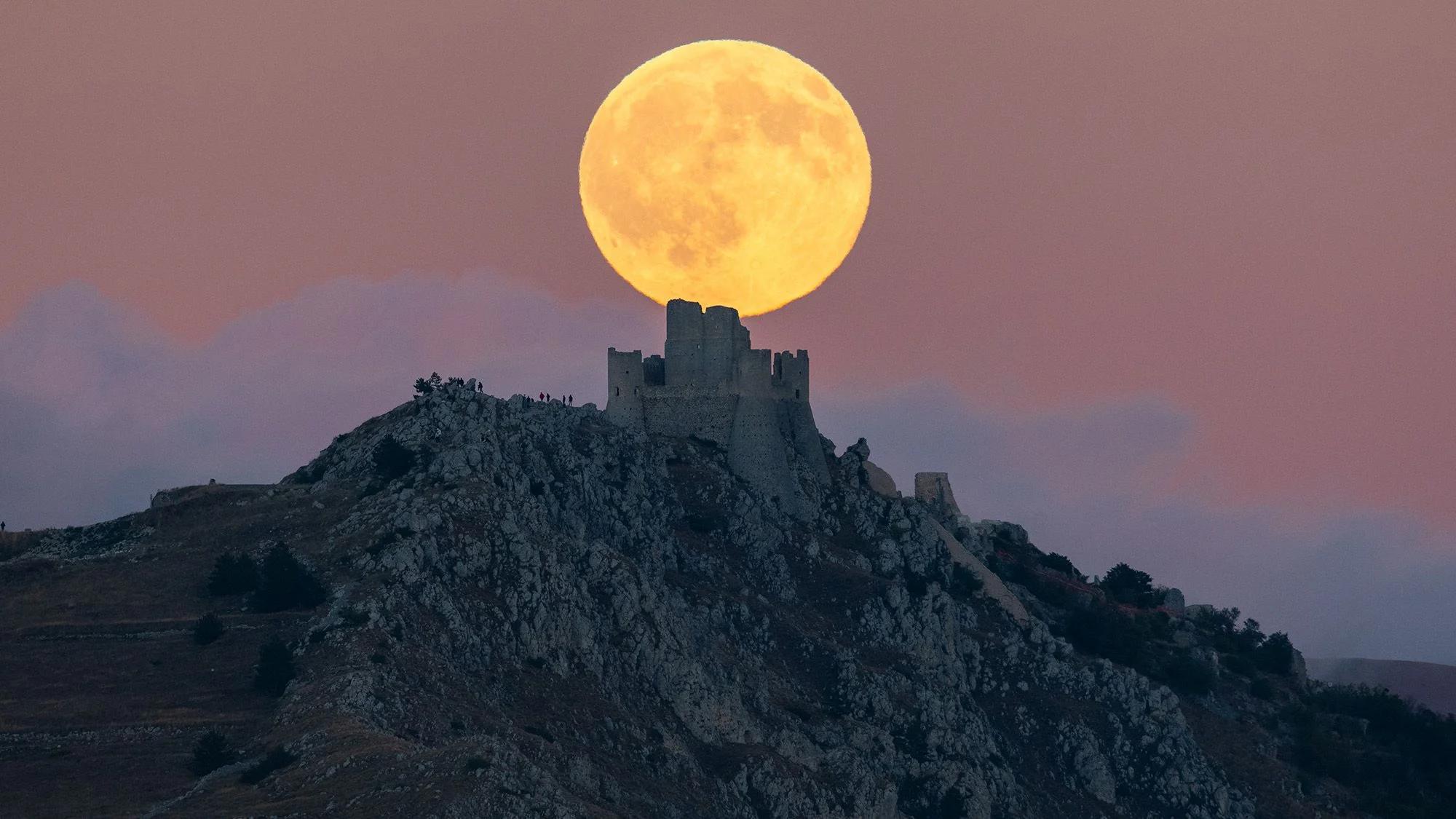
In short: The November 2026 full moon peaks on Tuesday, Nov. 24, at 9:53 a.m. EST (14:53 UTC), and it is a supermoon, about 224,170 miles (360,768 km) from Earth versus the average 238,900 miles (384,472 km). The best view comes at moonrise that evening. On Christmas Eve, the Cold Moon will be the closest, biggest and brightest full moon of the year and the closest since Jan. 2, 2018.
When is the Beaver Supermoon in November 2026, and what time should you look?
The exact full phase arrives at 14:53 UTC: 9:53 a.m. in New York, 2:53 p.m. in London and 4:53 p.m. in Kyiv. In North America the moon is below the horizon at that moment, so Live Science recommends waiting for moonrise on Tuesday evening.
Approximate moonrise times on Nov. 24:
- New York: about 4:15 p.m., sunset 4:31 p.m.;
- London: about 3:17 p.m., sunset 4:00 p.m.;
- Kyiv: about 3:18 p.m., sunset 4:02 p.m.
Trees, hills and buildings can delay the moon's appearance by anywhere from a few minutes to half an hour, Farmers' Almanac warns, so pick an open spot with a low eastern horizon. The moon will also look full on Monday and Wednesday, so you have backup nights.
What is a supermoon, and how much bigger does the moon look?
The moon's orbit is an ellipse, so its distance from Earth keeps changing. A supermoon is a full moon that coincides with the near point of that orbit, called perigee. Astrologer Richard Nolle coined the term in 1979, and there is still no single official threshold; EarthSky follows the method of the late astronomer Fred Espenak.
According to EarthSky, a supermoon's disk is up to 8% larger and about 16% brighter than an average full moon, and up to 14% larger and 30% brighter than a "micromoon" at the far point of the orbit. The giant look near the horizon is the moon illusion, and the orange tint comes from sunlight scattering through more of the atmosphere.
Why is it called the Beaver Moon?
The name comes from North America, where beavers finish their lodges and reinforce their dams in late autumn before the water freezes. It was also the season for trapping beavers for winter pelts. Other names include the Frost Moon, and the Anishinaabeg call it Baashkaakodin Giizis, "the Freezing Moon."
Which supermoon of 2026 is this, and what happens on Christmas Eve?
It is the second full supermoon of calendar year 2026, after the Wolf Moon on Jan. 3 (about 362,312 km). It also opens a run of three full supermoons in a row:
- Nov. 24, 2026, Beaver Moon: 360,768 km (224,170 miles), the most distant of the three;
- Dec. 24, 2026, Cold Moon: 356,740 km (221,667 miles), the closest, biggest and brightest full moon of 2026;
- Jan. 22, 2027, Wolf Moon: 357,644 km (222,229 miles).
The Cold Moon will be the closest full moon since Jan. 2, 2018, when it came within 356,603 km. Its exact peak falls at 01:28 UTC on Dec. 24, or 8:28 p.m. EST on Dec. 23, so watch both evenings. BBC Sky at Night Magazine, using a looser definition, counts four in a row through February 2027.
How do you photograph the supermoon with a smartphone?
- Give it a foreground. NASA photographer Bill Ingalls warns against shooting the moon "by itself with no reference to anything." On a phone, a wider shot with a skyline, tree or person works better than trying to zoom in on the disk.
- Lock focus, then dial exposure down. Tap and hold on the moon to lock focus, then slide your finger down so the disk doesn't blow out into a white blob.
- Stick to optical zoom. Digital zoom adds no real detail, BBC Sky at Night Magazine notes. Crop afterward instead.
- Keep it steady. A small tripod, a rock or a railing plus a two- or three-second timer removes hand shake, NASA advises.
- Shoot in twilight. Right after moonrise the sky is still bright enough to show both the moon and the landscape.
FAQ
What time does the Beaver Supermoon rise in New York?
Around 4:15 p.m. on Nov. 24, shortly before the 4:31 p.m. sunset. Look low in the east-northeast during twilight.
Do I need a telescope to see the supermoon?
No. Your eyes and a clear eastern horizon are enough, and 7x to 10x binoculars will show craters and the dark lunar seas in more detail.
When is the biggest full moon of 2026?
On Dec. 24, when the Cold Moon sits 356,740 km (221,667 miles) away, the closest full moon since January 2018.
Share
Read next

Ukraine's main Christmas tree 2026: 18 metres, lit on 6 December
Ukraine's main Christmas tree 2026 on Sofiiska Square will be 18 metres tall, built from 3,000 branches and lit on 6 December, funded by patrons.

Beaded tinsel: the vintage Christmas tree trend you can make in an evening
Beaded tinsel is the vintage Christmas tree trend taking over Instagram and TikTok. Where it came from, what it costs and how to make your own in an evening.

64% of Ukrainians Don't Trust Black Friday Discounts: Viber Poll
Black Friday 2026: 64% of Ukrainians don't trust the discounts, a Viber poll shows. What shoppers will buy on November 27 and how to spot a fake deal.
Comments 0
No comments yet. Be the first!